
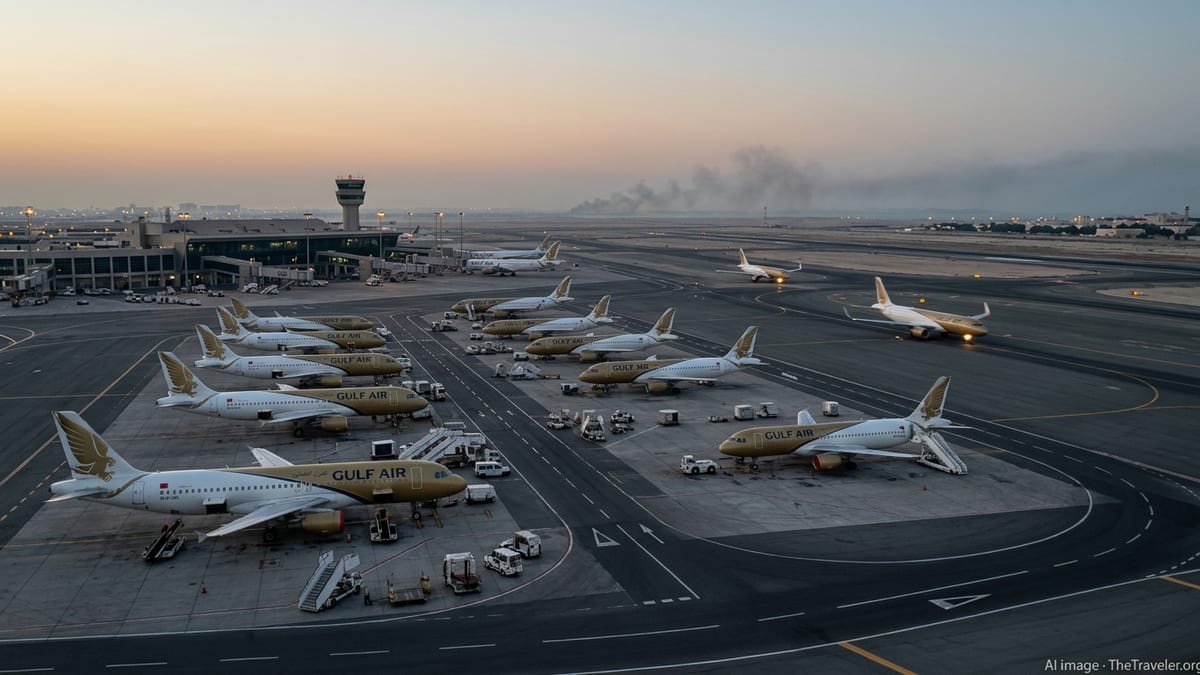
 Kuwait International Airport was hit by an Iranian drone attack on Wednesday, setting fuel storage tanks ablaze and forcing Kuwaiti authorities into another emergency response as the widening war across the Gulf pushed civilian infrastructure deeper into the line of fire. Officials said there were no immediate casualties, but the strike caused significant damage to fuel tanks belonging to Kuwait Aviation Fuelling Company, underlining how airports, ports and energy sites are becoming increasingly exposed as Tehran’s confrontation with the United States and Israel spills across neighbouring states.
 The attack was described by Kuwait’s civil aviation authorities as a direct hit on the airport’s fuel depots, with emergency teams deployed to contain what was characterised as a large fire. The strike did not appear to be an isolated episode. It came after earlier attacks on the airport complex, including damage reported to radar systems in late March, suggesting a pattern in which aviation facilities are being tested not only for physical resilience but also for their ability to preserve continuity under repeated hostile action. Kuwait’s challenge is no longer limited to air defence; it is now about protecting the arteries of a state that depends heavily on stable transport and energy logistics.
Airport fuel strike shakes Kuwait
That broader context matters. Gulf states told the United Nations Human Rights Council last week that Iranian attacks on infrastructure posed what Kuwait’s ambassador called an existential threat to regional and international security. The warning was not rhetorical. Across the Gulf, the conflict has already touched oil facilities, airports, shipping lanes and urban areas, while traders, airlines and insurers have been forced to price in a higher level of geopolitical risk. By Wednesday, Associated Press reporting indicated that Kuwait airport had been struck alongside other Iranian attacks in the Gulf, including a tanker off Qatar’s coast and business facilities in Bahrain, underscoring how the theatre of conflict now extends far beyond military targets.
For Kuwait, the symbolism is as important as the operational impact. Airports are visible markers of sovereign stability. A successful strike on fuel infrastructure sends a message that even well-guarded civilian gateways are vulnerable. That has implications for passenger confidence, airline scheduling, cargo movements and emergency planning, particularly in a region where major carriers and hubs function as vital connectors between Asia, Europe and Africa. Even when flights are not fully halted, repeated security incidents can degrade reliability, raise operating costs and intensify scrutiny of airport resilience, fuel storage safety and backup systems. The effect tends to spread quickly through sectors such as tourism, trade, insurance and aviation services.
The strike also feeds into a larger shift in modern conflict, in which drones are used not only to inflict direct damage but to unsettle economic infrastructure at relatively low cost. Fuel depots, radar stations and port assets are attractive targets because they can create immediate disruption without necessarily producing mass casualties. That logic appears to be shaping this phase of the war. Reuters reported that Wednesday’s attack was the latest in several strikes on Kuwait airport and its fuel storage areas, while other dispatches from the past week show Gulf states publicly hardening their language and appealing for stronger international scrutiny. Civilian infrastructure, once considered somewhat insulated, is now being drawn into the centre of strategic coercion.
Another pressure point is energy. Attacks on airports and tankers are occurring while shipping through the Strait of Hormuz remains under intense strain, helping push oil prices higher and stirring anxiety in importing economies. AP reported that Brent crude had risen sharply since the conflict began and that Tehran’s pressure on shipping had become a central concern for governments and markets alike. Kuwait sits at the intersection of those worries: it is both an oil producer and a transport node. Damage to airport fuel infrastructure therefore carries significance beyond the immediate fire. It speaks to the vulnerability of systems that underpin the wider Gulf economy, from export logistics to civil aviation.
Diplomatically, the incident is likely to reinforce calls from Gulf capitals for stronger protection of civilian sites and clearer consequences for attacks on them. The UN rights chief has already warned that deliberate strikes on civilians and civilian infrastructure may amount to war crimes. At the same time, the politics remain complicated. Oman has pointed out that the escalation followed earlier US-Israeli strikes on Iran, reflecting a region where condemnation of the attacks is sharp but views on the conflict’s origins are more varied. That tension is likely to shape the next round of diplomacy just as much as the fire itself.
Topics
Kuwait