
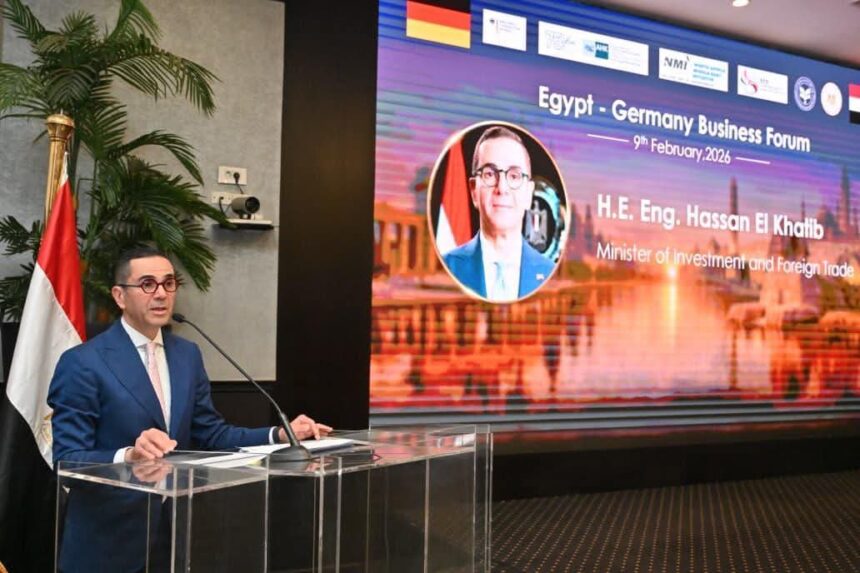
 Egypt underscored the growing significance of its economic engagement with Europe’s largest economy as Investment and Foreign Trade Minister Hassan El-Khatib told a business gathering that more than 1,500 German firms are now operating in the country, with total investments valued at about $4.9 billion. The remarks were delivered at the Egyptian-German Business Forum in Cairo, where officials and business leaders outlined ambitions to deepen commercial ties amid shifting global supply chain dynamics and a push for diversified industrial cooperation.
 El-Khatib opened the forum alongside Stefan Rouenhoff, Parliamentary State Secretary at Germany’s Federal Ministry for Economic Affairs and Energy, and Jürgen Schulz, Germany’s ambassador to Egypt, emphasising that Cairo and Berlin share longstanding economic links underpinned by trade and investment. The minister pointed to bilateral trade reaching about $5.1 billion in 2025 under the framework of the Egypt-European Union Partnership Agreement, which grants preferential access to European markets and has bolstered volumes of goods exchanged between the two economies.
The forum unfolded against a backdrop of broader economic reforms and infrastructure investments in Egypt, with government officials highlighting improvements in macroeconomic indicators as factors driving foreign investor confidence. El-Khatib noted efforts to shift monetary policy towards inflation targeting, contributing to a decline in inflation from peak levels to around 12 per cent, while foreign reserves climbed above $50 billion and remittances from Egyptians abroad approached $37 billion. He also cited a steep rise in tax revenues and steps taken to reduce trade and logistics costs, which have helped narrow Egypt’s trade deficit.
Officials described the presence of German firms spanning a range of sectors as central to deepening industrial linkages. Beyond traditional engineering and manufacturing activities, Cairo is tailor-making opportunities in high-growth areas such as automotive components, renewable energy and green hydrogen, advanced industrial inputs, electronics and semiconductors. The minister voiced optimism that enhanced cooperation could position Egypt as a regional hub for low-carbon exports and technology transfer.
Rouenhoff echoed this sentiment, describing rising interest among German companies in expanding operations in Egypt. Citing infrastructure development and improvements in the business environment, he highlighted projects by German multinationals such as Siemens, which has long engaged in transport and energy infrastructure in Egypt. The state secretary characterised the forum as an opportunity to consolidate trusted partnerships at a time when global firms are recalibrating supply chains in pursuit of resilience and new market access.
Economic planners and trade officials at the forum reiterated targets that extend beyond current investment figures. Cairo aims to attract more German investment and is working to nearly double the number of German firms in the Egyptian market by 2030, more than tripling their footprint from present levels. Enhanced export flows to Germany are also on the agenda, with ambitions to raise annual Egyptian exports to at least €3 billion within five years, supported by trade facilitation reforms and digital platforms designed to simplify cross-border commerce.
The German presence in Egypt reflects broader trends in European-North African economic cooperation, where firms seek strategic production locations that offer access to multiple regional markets. Germany’s engagement encompasses both established industries and emerging domains such as renewable energy, where Egypt’s capacity to host large-scale solar and wind projects dovetails with German expertise in technology and sustainable solutions. Officials from both sides underscored the potential for green industrial growth to attract further investment and employment.
Despite the positive signals, challenges remain on the path to more robust bilateral economic relations. Investors have pointed to the need for continued reform momentum, regulatory clarity and greater predictability in policy frameworks as preconditions for scaling up commitments. Business groups also emphasised the importance of supporting small and medium enterprises and integrating local supply chains to ensure that foreign direct investment catalyses broader economic development.
Topics
Live News