
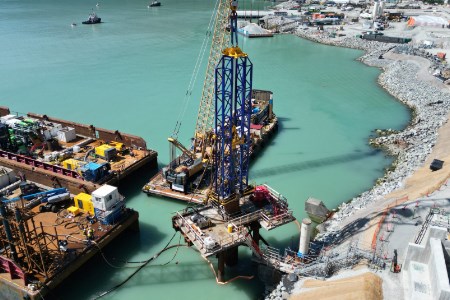
 Construction activity at Woodfibre LNG near Squamish has gathered momentum through 2025, marking a pivotal phase for one of Canada’s most closely watched liquefied natural gas developments. Project partners say the year has been defined by visible progress on core infrastructure alongside a sharpened focus on environmental controls and long-term collaboration with neighbouring communities, particularly the Squamish Nation, whose reserve lands lie adjacent to the site.
The floating LNG facility, designed to produce about 2.1 million tonnes of LNG a year for export to Asian markets, has moved deeper into its construction schedule following final investment approval and permitting milestones secured earlier. Work over the past months has centred on marine infrastructure, site preparation, and fabrication activities tied to the floating production, storage and offloading unit that will anchor the project. Company updates indicate that construction timelines remain aligned with targets set after the project’s ownership structure was finalised.
Woodfibre LNG is majority owned by Pacific Energy Corporation, controlled by Singapore-based businessman Sukanto Tanoto, with the Squamish Nation holding a 10 per cent equity stake. That ownership model continues to draw attention within Canada’s energy sector, where Indigenous participation in major resource projects has become an increasingly significant factor in regulatory and social licence discussions. For the Squamish Nation, the project is positioned as both an economic opportunity and a test of whether large-scale energy development can coexist with environmental and cultural priorities.
Environmental stewardship has been emphasised as construction has accelerated. The project has committed to operating as an all-electric LNG facility, drawing power from British Columbia’s hydroelectric grid rather than using gas turbines, a design choice aimed at reducing operational emissions intensity. Company statements through 2025 have reiterated that this approach is intended to make Woodfibre one of the lowest-emissions LNG facilities globally, a claim that has been scrutinised by environmental groups and analysts alike.
Regulatory oversight remains tight. Federal and provincial conditions attached to approvals require continuous monitoring of marine ecosystems in Howe Sound, a fjord that has seen ecological recovery over the past decade after years of industrial decline. Measures during construction include timing restrictions to protect fish habitats, noise management protocols to limit underwater disturbance, and ongoing engagement with environmental monitors appointed in consultation with the Squamish Nation. Independent assessments commissioned under the approval framework continue to inform adaptive management as construction progresses.
Community partnership has been another defining theme of 2025 for the project. Employment and training programmes linked to construction have prioritised local hiring, with agreements in place to channel contracting opportunities to Indigenous and regional businesses. The Squamish Nation has highlighted capacity-building initiatives tied to the project, including apprenticeships and long-term revenue streams expected to support housing, education and cultural programmes beyond the construction phase.
At the same time, the development has faced sustained opposition from environmental advocates who argue that any new LNG export capacity risks locking in fossil fuel dependence at odds with climate targets. Protest actions and legal challenges mounted in previous years continue to shape public debate, even as courts and regulators have upheld the project’s approvals. Woodfibre LNG’s proponents counter that LNG exports can displace higher-emissions coal use in parts of Asia and that Canada’s regulatory standards offer a comparatively lower-carbon supply option.
Market context has also influenced perceptions of the project’s progress. Global LNG demand forecasts remain robust, driven by energy security concerns and long-term supply contracts sought by utilities in Asia. For British Columbia, Woodfibre LNG represents a smaller-scale alternative to mega-projects, with a footprint and output designed to limit environmental impact while still tapping into export opportunities. Analysts note that its floating design reduces the need for extensive onshore infrastructure, a factor cited by supporters as an advantage in a sensitive coastal setting.
Chronologically, 2025 sits between the completion of early works and the more complex integration stages that will follow. Fabrication of major components overseas and their eventual transport to the site will be among the next critical steps, carrying logistical and scheduling risks familiar to LNG developments worldwide. Project management teams have pointed to lessons learned from other global LNG builds, emphasising modular construction and supply-chain coordination to avoid cost overruns.
Topics
Live News