
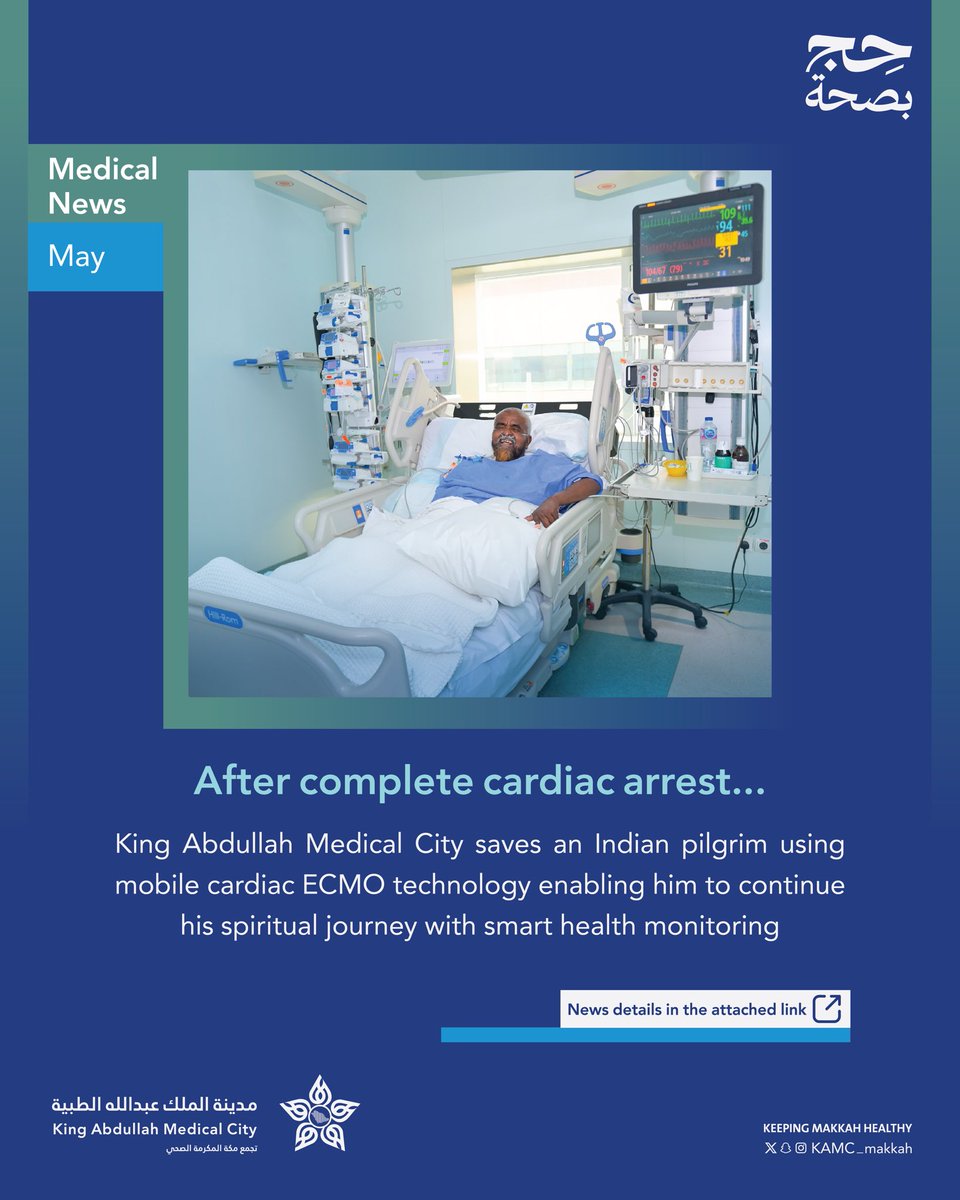
 Saudi cardiac teams in Makkah saved the life of a pilgrim from India after a heart attack led to complete cardiac and circulatory arrest, using a mobile veno-arterial extracorporeal membrane oxygenation system during one of the most demanding phases of the Hajj season.
The intervention at King Abdullah Medical City, a specialist facility within the Makkah Health Cluster, underscored the growing role of advanced critical-care mobility in Saudi Arabia’s management of the annual pilgrimage. The patient suffered a severe cardiac event that required rapid resuscitation, intensive cardiac support and coordinated action by emergency, cardiology, perfusion and intensive-care teams.
Mobile V-A ECMO is used in life-threatening situations when the heart and lungs cannot maintain adequate blood flow and oxygen delivery. The system temporarily takes over part of the circulatory and respiratory function, allowing doctors to stabilise the patient while they treat the underlying cause of collapse. Its deployment outside a conventional operating-room setting requires trained specialists, rapid diagnosis and a tightly organised transfer pathway.
The patient was placed under intensive care after the emergency intervention, with follow-up led by a multidisciplinary medical team. The case added to a series of critical cardiac procedures carried out in Makkah as Saudi authorities scale up health services for more than 1.5 million pilgrims during Hajj 2026, including 175,025 pilgrims from India.
King Abdullah Medical City has become a key referral centre for high-risk Hajj cases because of its proximity to the holy sites and its specialised cardiac services. The medical city, inaugurated in 2009, has a capacity of about 1,500 beds and houses specialised centres for heart health, oncology, neurological care, organ transplantation, endoscopy, liver treatment, eye care and complex surgery.
The timing of the intervention is significant. Hajj 2026 is taking place in late May, with large numbers of pilgrims moving between Makkah, Mina, Arafat and Muzdalifah under intense physical strain. Cardiovascular events remain a major concern during the pilgrimage, particularly among elderly pilgrims and those with diabetes, hypertension, coronary artery disease or other chronic conditions.
Saudi health authorities have expanded emergency readiness for this year’s pilgrimage through hospitals, field clinics, ambulance services, virtual monitoring, specialist referral systems and rapid-response teams across Makkah and the holy sites. The Ministry of Health has also maintained programmes to strengthen staffing at Hajj facilities, including support for hospitals in the central area and the holy sites.
The case also highlights a broader shift in pilgrimage healthcare from reactive emergency response to pre-positioned specialised care. Cardiac catheterisation laboratories, intensive-care beds, emergency transport routes and digital coordination systems are increasingly integrated into the Hajj medical network, reducing delays when patients suffer heart attacks, strokes, heat exhaustion or respiratory failure.
For pilgrims from India, the 2026 season includes expanded welfare arrangements, digital facilitation through the Haj Suvidha App, smart wristbands to support identification and assistance, enhanced insurance coverage and improved medical screening before travel. These measures are intended to reduce avoidable risk, although the scale and physical demands of the pilgrimage continue to test health systems in both origin countries and Saudi Arabia.
Cardiac specialists regard early intervention as critical in cases of complete circulatory arrest. Delays of even a few minutes can increase the risk of brain injury, multi-organ failure or death. Mobile ECMO can be decisive when conventional resuscitation is insufficient, but it is resource-intensive and requires specialised personnel capable of placing cannulas, managing anticoagulation, monitoring circulation and responding to complications.
The successful use of mobile ECMO during Hajj also reflects Saudi Arabia’s wider healthcare transformation agenda, which has placed emphasis on emergency preparedness, specialised referral networks and technology-driven medical services. Hajj presents one of the most complex public health operations in the world, combining mass movement, heat exposure, language barriers, chronic disease burden and the need for immediate treatment across dispersed locations.
Medical experts have repeatedly identified non-communicable risks, including heat-related illness, cardiometabolic collapse, trauma and fatigue, as persistent hazards during Hajj. Infectious-disease surveillance remains essential, but cardiac and critical-care capability has become equally important as pilgrim demographics include many older worshippers undertaking physically demanding rituals after long-distance travel.
Topics
Saudi Arabia