
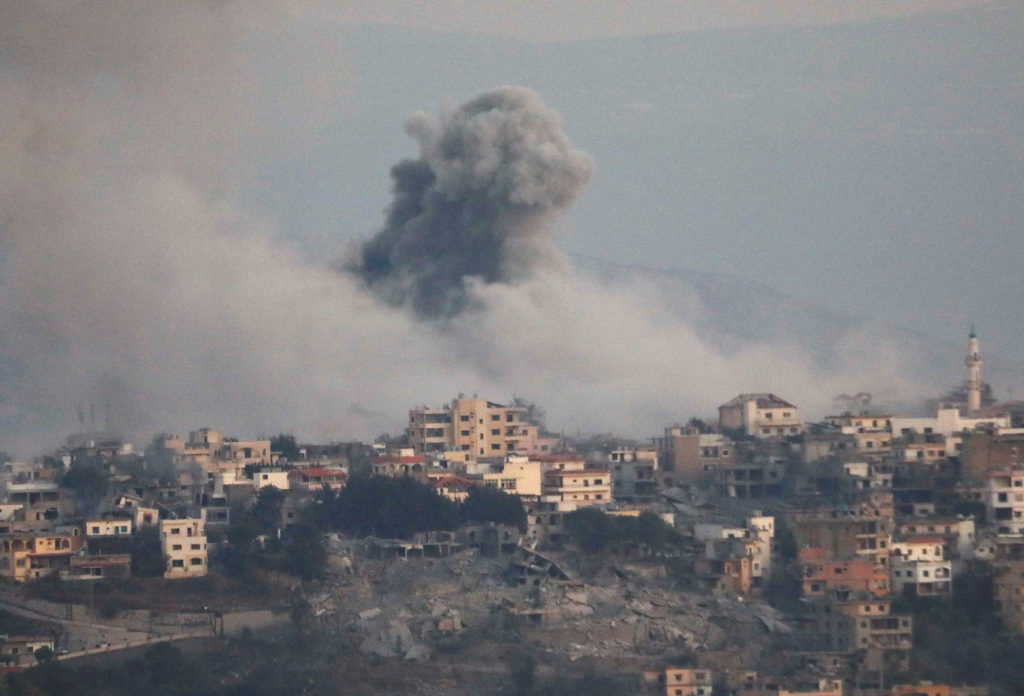
 Israeli warplanes struck Beirut on Friday after the military told residents in seven neighbourhoods of the capital’s southern suburbs to leave, widening pressure on Lebanon’s capital as Washington warned that Iran and allied groups could target universities in the country. The attacks came as the regional war continued to spill across borders, drawing Lebanon deeper into a conflict already shaped by Israeli operations against Hezbollah and the wider U. S.-Israeli campaign against Iran.
 Three loud blasts were heard across Beirut around sunset, with Lebanese media reporting that the strikes hit the southern suburbs, an area long associated with Hezbollah’s political and military presence. Israel said it had struck what it described as “terror infrastructure” in Beirut, but did not immediately provide details on the specific targets or any assessment of casualties. The timing of the bombardment, on the day many Lebanese Christians were marking Good Friday, sharpened the sense of a city under mounting strain.
The U. S. warning added a new layer of alarm. Washington said Iran and aligned militias might intend to target universities in Lebanon after Tehran threatened retaliation over attacks on Iranian academic institutions. The American University of Beirut shifted classes online earlier in the week as a precaution, while the U. S. embassy renewed its advice that American citizens should leave Lebanon. Across the region, other U. S.-linked universities have also tightened security or altered teaching arrangements after Iranian threats broadened beyond military and diplomatic sites.
Friday’s strikes were not an isolated episode but part of a fast-moving escalation. Reuters reported that Israeli attacks in the Beirut area earlier in the week killed at least seven people and wounded 24, with one strike hitting a vehicle in Khaldeh south of the capital and another hitting the Jnah area. Israel said those attacks targeted senior Hezbollah figures, though it did not publicly identify them. Hezbollah did not immediately comment. The sequence underlined how the battlefield has shifted beyond the frontier and into densely populated urban areas around Beirut.
The broader conflict has accelerated since March 2, when Hezbollah fired into Israel in solidarity with Iran after U. S. and Israeli strikes began on Iranian territory. Israel has since expanded military operations in Lebanon and said it aims to occupy territory up to the Litani River as part of a security belt for its northern border communities. That objective has raised fears of a prolonged military presence and a deeper rupture in Lebanon’s already fragile political and economic order.
The humanitarian toll is rising sharply. Reuters reported that 1,368 people have been killed in Israeli strikes and about a fifth of Lebanon’s population has been displaced, while AP said more than one million people have fled southern and eastern Lebanon as well as Beirut’s southern suburbs. Evacuation orders now cover roughly 15% of Lebanese territory, according to humanitarian estimates cited by AP and Reuters, forcing families into Beirut, where parks, seafront areas, mosques and vacant storefronts have become makeshift shelters.
Those numbers are reshaping the capital. AP described a city struggling to absorb families arriving with little more than what they could carry, with tent encampments appearing along the waterfront and in open spaces. Aid groups have warned that the displacement wave is not only a logistical burden but a political flashpoint in a country already weakened by financial collapse, institutional paralysis and deep sectarian divisions. Every new Israeli warning to evacuate more areas risks pushing Beirut closer to a full-blown urban humanitarian emergency.
The conflict has also endangered international personnel. On Friday, three peacekeepers with the U. N. Interim Force in Lebanon were injured, two of them seriously, in an explosion inside a U. N. position near Al-Aadaissah in the south, according to UNIFIL’s spokesperson as cited by Reuters. Israel said the blast was caused by Hezbollah rocket fire from an area north of the U. N. post. Earlier in the week, three Indonesian peacekeepers were killed, while another incident in early March left Ghanaian peacekeepers wounded by Israeli tank fire, for which Israel expressed regret.
Diplomatically, Lebanon is caught between armed escalation and outside pressure. AP has reported growing tensions between Beirut and Tehran, including disputes over Iran’s ambassador and broader efforts by Lebanese authorities to curb Iranian and Hezbollah military activity on Lebanese soil. That internal strain complicates any attempt by the Lebanese state to present a coherent response, especially as residents in some southern communities refuse to leave despite advancing Israeli operations and repeated evacuation orders.
Topics
World