
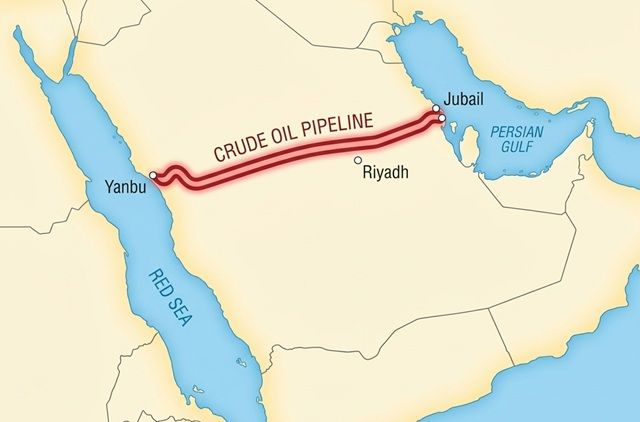
 Saudi Arabia has pushed crude exports from its Red Sea port of Yanbu close to the terminal’s working limit, turning the facility into the kingdom’s main route to world markets as the Strait of Hormuz remains heavily disrupted and oil buyers scramble for alternative supply. Shipping data tracked by Kpler and LSEG showed Yanbu exports at about 4.6 million barrels per day last week, up sharply from an average of about 770,000 barrels per day in January and February and moving towards the port’s estimated export ceiling of roughly 5 million barrels per day.
 That jump matters well beyond Saudi Arabia. The kingdom is the largest crude exporter in OPEC and one of the very few producers with infrastructure that can partially bypass Hormuz. Aramco said on March 10 that it could pump as much as 7 million barrels per day through its East-West pipeline system to Yanbu, though only about 5 million barrels per day would be available for export after local refinery demand is met. Analysts had already expected Yanbu loadings to approach that limit by the end of March, and the latest figures suggest the workaround is now being tested at scale.
Pressure on this route has grown because Hormuz remains the key artery for Gulf energy exports. The International Energy Agency said nearly 15 million barrels per day of crude, equal to about 34% of global crude oil trade, passed through the strait in 2025, while total oil flows through the waterway were close to 20 million barrels per day. The agency also warned that only Saudi Arabia and the UAE have operational crude pipelines capable of rerouting flows around Hormuz, and even those alternatives offer limited spare capacity compared with the scale of normal traffic through the channel.
Saudi Arabia’s pivot to Yanbu has therefore become the clearest illustration of both resilience and constraint in the Gulf oil system. It shows that Riyadh can redirect substantial volumes away from the Gulf coast when security conditions deteriorate, but it also underlines how quickly that flexibility can run into hard physical limits. Once Yanbu is effectively full, the kingdom has little additional room to expand exports to customers in Asia, Europe or other markets without a reopening of Hormuz or a reduction in domestic refinery demand. Reuters reported that Yanbu is currently the only Saudi port capable of shipping crude to other regions under these circumstances.
The market impact is already visible. Brent settled at $112.78 a barrel on March 30, while U. S. crude closed above $100 for the first time since 2022. Reuters reported that Brent prices have risen about 57% this month, reflecting fears that the conflict could tighten global supplies further. The squeeze is especially acute in Asia, which depends heavily on Middle East barrels and is now competing more aggressively for crude from West Africa, Europe and the Atlantic Basin. Traders and analysts told Reuters that this shift has driven premiums for some physical grades to record highs and diverted cargoes that would usually head to European buyers.
Shipping costs have also surged as tankers are repositioned and voyages become more complicated. Reuters said average earnings for crude tankers sailing from the Red Sea to Asia climbed to nearly $270,000 a day, the highest level in almost six years. Brokers have described Middle East tanker markets as chaotic, with more Saudi cargoes rerouted through Yanbu and a growing queue of very large crude carriers loading at the port. That raises another vulnerability: the workaround itself is exposed to military risk along the Red Sea corridor.
That vulnerability is no longer theoretical. Reuters reported on March 19 that the SAMREF refinery at Yanbu was targeted in an aerial attack, though an industry source said the impact was minimal. Loadings at Yanbu were also briefly halted last week after an Iranian drone attack on a refinery there, before resuming. At the same time, wider fears have grown that any expansion of Houthi operations in the Red Sea could threaten the southern approach to the route through Bab el-Mandeb, creating a second chokepoint problem for cargoes that have already been diverted away from Hormuz.
Topics
Live News