
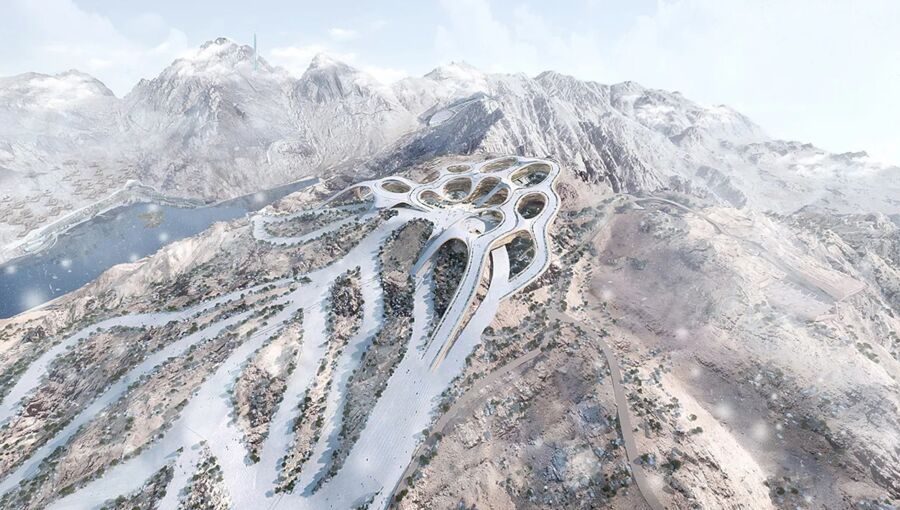
 Saudi Arabia’s futuristic NEOM has terminated a key structural steel contract with Eversendai Corporation for work at the Trojena Ski Village, signalling fresh strain on timelines and contractor alignment within one of the kingdom’s most ambitious developments.
Eversendai disclosed that it had received formal notice cancelling its role in delivering structural steel works for the Trojena project, a flagship mountain tourism destination within NEOM. The company indicated that the termination was linked to geopolitical developments affecting project execution, though specific details were not publicly outlined. The decision marks a significant shift in contractor arrangements for Trojena, which has been positioned as a cornerstone of Saudi Arabia’s diversification strategy under Vision 2030.
Trojena, located in the mountainous region of NEOM, is designed to host year-round outdoor activities including winter sports, despite the desert climate. The project gained global attention after being selected to host the 2029 Asian Winter Games, placing pressure on developers to maintain construction schedules and deliver critical infrastructure on time. Structural steel forms a core component of the resort’s architecture, particularly for large-span buildings and ski-related facilities, making the termination of a major contractor a notable development.
Eversendai, known for its expertise in complex steel structures and its involvement in landmark projects across the Middle East and Asia, had secured the Trojena contract as part of a broader push into large-scale infrastructure tied to Gulf economic transformation plans. The company has previously worked on high-profile developments including airports, stadiums and energy facilities, positioning itself as a specialist in technically demanding builds. Its removal from the Trojena project raises questions about contract risk and execution challenges faced by international contractors operating in evolving geopolitical and logistical environments.
The reference to geopolitical factors comes at a time when global supply chains remain sensitive to regional tensions, trade restrictions and cost volatility. Steel procurement, fabrication and delivery are particularly exposed to such disruptions, as projects rely on coordinated international sourcing and transport networks. Industry analysts note that large-scale developments such as NEOM, which depend heavily on imported materials and specialised engineering expertise, are especially vulnerable to external shocks.
Saudi Arabia has been accelerating work on NEOM despite mounting scrutiny over costs, feasibility and timelines. The project, estimated to cost hundreds of billions of dollars, encompasses multiple sub-developments including The Line, Oxagon and Trojena. Officials have repeatedly emphasised that phased execution and contractor restructuring are part of normal project evolution, although contract cancellations can also reflect tighter cost controls or shifts in design priorities.
Within this context, the termination of Eversendai’s contract may signal a recalibration of procurement strategies as developers seek to optimise delivery. Large infrastructure programmes often involve reassignment of contracts to different firms, renegotiation of terms or consolidation of work packages to improve efficiency. However, such changes can introduce delays, particularly when replacement contractors must be mobilised and integrated into complex project frameworks.
Market reaction to Eversendai’s disclosure has focused on the financial and operational implications for the company. While the firm did not specify the value of the terminated contract in detail, analysts suggest that Trojena represented a meaningful component of its order book. Contract cancellations can affect revenue visibility and margins, especially when they involve partially executed work or require redeployment of resources.
The broader construction sector in the Gulf continues to experience both opportunity and uncertainty. Mega-projects driven by state-backed investment have created strong demand for engineering, procurement and construction services, attracting global contractors. At the same time, evolving regulatory frameworks, localisation requirements and geopolitical considerations have added layers of complexity to project execution.
For NEOM, maintaining momentum across its various components remains critical to sustaining investor confidence and meeting strategic targets. Trojena, in particular, plays a symbolic role as a showcase of technological innovation and environmental adaptation. Delivering a ski resort in a desert environment involves advanced engineering solutions, including artificial snow systems, temperature control and sustainable water management, all of which depend on precise coordination among contractors.
Topics
Live News