
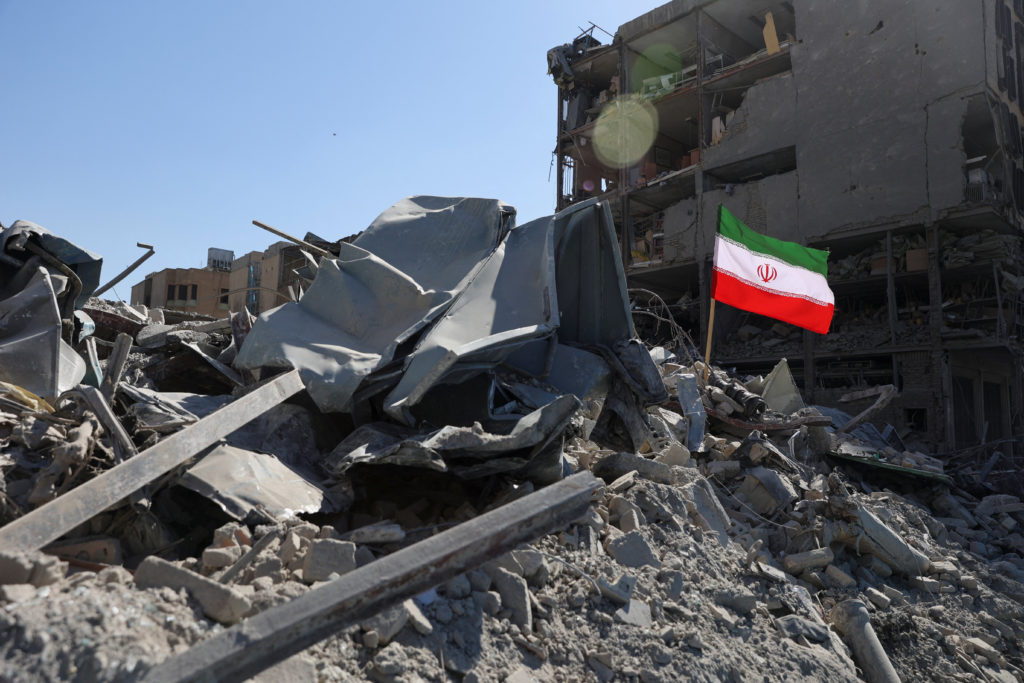
 Tehran has widened its retaliation in the escalating regional war, striking Prince Sultan Air Base in Saudi Arabia after Israeli attacks on Iranian nuclear-related facilities deepened the confrontation and pushed Gulf states closer to the line of fire. The Iranian strike wounded 12 US troops, two of them seriously, according to a US official, underlining how quickly a conflict centred on Israel and Iran is spilling across the wider Middle East.
 The attack on the Saudi base marked one of the clearest signs yet that infrastructure on Gulf soil is becoming a direct arena in the war, even when the personnel hit are American rather than Saudi. Prince Sultan Air Base has long hosted US forces, and the strike sharpened concern in Riyadh and across neighbouring capitals that the conflict is eroding the buffer that Gulf states have tried to maintain while balancing security ties with Washington and a cautious diplomatic opening with Tehran.
Israel’s latest military action against Iran centred on two nuclear-related sites identified by Israeli and international reporting as the Khondab heavy-water plant near Arak and the Shahid Rezayee Nejad yellowcake production facility in Ardakan, Yazd province. Those strikes followed earlier attacks on Iran’s Natanz nuclear facility, which Tehran told the International Atomic Energy Agency had also been hit in joint US-Israeli operations at the start of March. No radiation leak was reported from the two sites struck on Friday, but the symbolism was potent: Israel was signalling that it would keep targeting components of Iran’s nuclear programme beyond enrichment halls alone.
For Tehran, the response appears designed to send several messages at once. By striking a base in Saudi Arabia that hosts US forces, Iran showed it retains the capacity to impose costs on Washington’s regional military footprint even after weeks of bombardment. By avoiding, at least on the available evidence, mass Saudi casualties, it also appeared to be calibrating its response to maintain pressure without automatically forcing every Gulf monarchy into an overt war posture. That calculation is fraught. Any attack on Saudi territory carries the risk of tightening defence coordination among Gulf Arab states, the United States and Israel, particularly as missile and drone threats spread across the region.
The human and strategic toll of the conflict is mounting. Reuters reported that more than 300 US military service members have been wounded since the war against Iran began on February 28, with 273 having returned to duty and 13 killed. Associated Press reporting said the strike on Prince Sultan also damaged refuelling aircraft, indicating Iran is not merely attempting to create political shock but also to disrupt operational logistics that sustain long-range air campaigns. That matters because aerial refuelling is central to maintaining pressure across vast distances stretching from the eastern Mediterranean to the Gulf.
The wider battlefield is also broadening in other directions. Yemen’s Houthis have claimed their first missile launch on Israel since this phase of the war began, drawing another Iran-aligned actor more directly into the confrontation. At the same time, Israeli strikes have continued across Iranian territory and in Lebanon, while Iran has kept up missile and drone attacks not only on Israel but on Gulf-linked targets. The result is a regional conflict that no longer looks containable through narrow military signalling alone. Shipping lanes, oil infrastructure and bases hosting foreign troops are all now part of the strategic equation.
That raises the stakes for Saudi Arabia. Riyadh has spent the past few years trying to reduce direct confrontation with Tehran while preserving its security partnership with Washington. The strike on Prince Sultan challenges that balancing act. Saudi leaders must now weigh whether restraint still offers protection, or whether the geography of US deployments on their territory makes neutrality impossible in practice. Gulf governments that had hoped to insulate domestic economic programmes from regional turmoil are instead facing the prospect of higher security costs, renewed investor anxiety and further threats to energy and trade routes.
Diplomatic efforts are continuing, but with uncertain prospects. Reuters and other reports said Pakistan was set to host talks involving Saudi Arabia, Turkey and Egypt as governments search for a formula to prevent further deterioration. Yet the military facts on the ground are moving faster than mediation. Israeli attacks on nuclear-related sites, Iranian retaliation against bases in Saudi Arabia, and the entry of additional allied armed groups into the war together point to a conflict that is becoming more decentralised, more dangerous and harder for any single capital to control.
Topics
Live News