
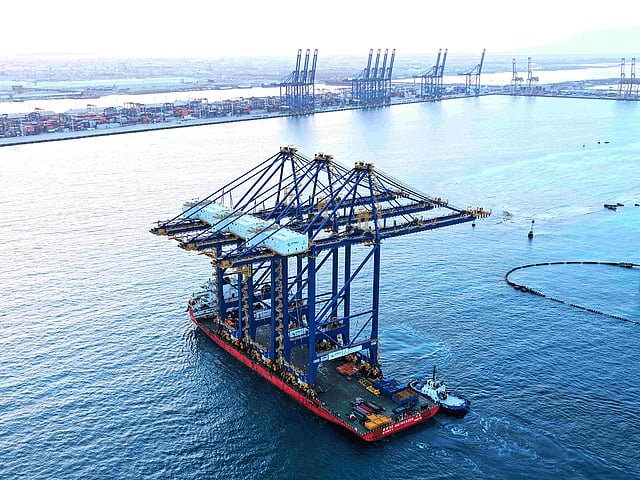
 DP World has strengthened its operational footprint along the Red Sea by adding three new ship-to-shore cranes at its terminal, lifting total crane capacity from 14 to 17 and signalling a push to handle growing maritime traffic along one of the world’s most critical trade corridors.
The cranes, manufactured by Shanghai Zhenhua Heavy Industries Company, are undergoing final commissioning and are expected to enhance berth productivity, reduce vessel turnaround times and accommodate larger container ships. The development comes as global shipping routes through the Red Sea regain strategic prominence amid shifting trade patterns and evolving logistics demands.
DP World said the deployment forms part of a broader capacity expansion plan aimed at improving efficiency and resilience across its port network. The terminal, located along a key maritime artery linking Europe, Asia and Africa, has seen sustained pressure to scale up operations as container volumes fluctuate and shipping lines seek faster, more reliable turnaround.
Industry analysts note that the addition of high-capacity cranes allows ports to handle ultra-large container vessels more effectively, a trend driven by shipping alliances consolidating cargo onto fewer but bigger ships. The new equipment is designed to operate at greater outreach and lifting speeds, enabling simultaneous handling of multiple container rows and reducing idle berth time.
Port operators across the Red Sea region have been investing in infrastructure upgrades to capture transhipment traffic and serve as redistribution hubs for regional markets. DP World’s move aligns with this competitive dynamic, where efficiency gains and technological upgrades are increasingly decisive in attracting global shipping lines.
The expansion also reflects a wider recalibration of global supply chains. Disruptions in traditional routes and the need for diversified logistics pathways have elevated the importance of ports positioned along alternative corridors. The Red Sea, connecting the Suez Canal to major Asian and European markets, remains central to this network, even as geopolitical and security considerations periodically disrupt traffic flows.
Executives familiar with the project indicated that the new cranes incorporate advanced automation features, including remote operation capabilities and real-time monitoring systems. These technologies are intended to improve safety standards while optimising operational throughput. Automation has become a defining feature of next-generation ports, enabling operators to manage higher volumes with greater precision.
The commissioning process involves rigorous testing of mechanical, electrical and digital systems to ensure integration with existing terminal infrastructure. Once fully operational, the cranes are expected to contribute to a measurable increase in annual container handling capacity, although DP World has not disclosed specific throughput targets linked to this upgrade.
Shipping industry observers point to a gradual rebound in container volumes following periods of volatility driven by pandemic-era disruptions and subsequent inventory corrections. While demand patterns remain uneven across regions, strategic investments in port infrastructure suggest that operators are positioning for medium-term growth rather than short-term fluctuations.
Competition among regional ports has intensified as governments and private operators seek to establish logistics hubs capable of serving expanding trade flows between emerging markets. Facilities along the Red Sea are particularly well placed to capitalise on this trend, given their proximity to both manufacturing centres in Asia and consumer markets in Europe and Africa.
DP World’s investment also underscores the role of integrated logistics solutions in modern port operations. Beyond crane capacity, the company has been expanding its end-to-end supply chain services, including inland logistics, warehousing and digital platforms designed to streamline cargo movement. Such integration is increasingly viewed as essential to maintaining competitiveness in a fragmented global logistics landscape.
Market participants caution, however, that infrastructure expansion alone may not offset broader uncertainties affecting maritime trade. Factors such as freight rate volatility, geopolitical tensions and regulatory shifts continue to shape shipping dynamics. Ports must therefore balance capacity growth with operational flexibility to respond to sudden changes in demand.
The addition of the three cranes is expected to provide a buffer against congestion, a persistent challenge in high-traffic terminals. By increasing the number of simultaneous vessel operations, the terminal can reduce queuing times and improve schedule reliability for shipping lines, a key consideration in an industry where delays can cascade across global networks.
DP World has maintained a steady pace of capital expenditure across its global portfolio, targeting both emerging and established markets. The Red Sea expansion forms part of this broader strategy, reflecting confidence in the region’s long-term trade potential despite intermittent disruptions.
Topics
Live News