
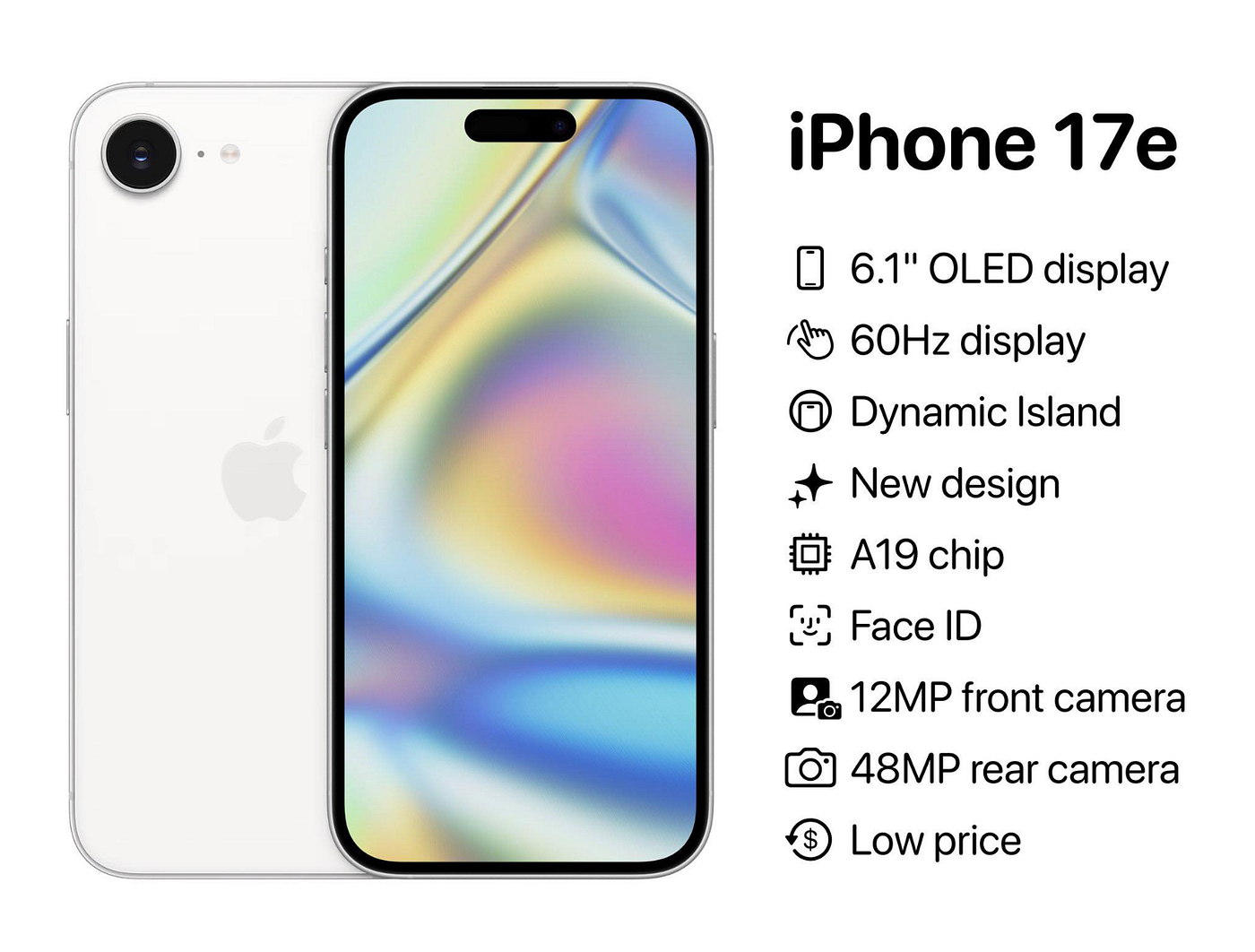
 Apple has expanded its smartphone portfolio with the iPhone 17e, a lower-priced device designed to deliver much of the performance of the flagship iPhone 17 while trimming select premium features to maintain affordability. The launch underscores a growing shift in Apple’s strategy to strengthen its position in the mid-range smartphone segment while preserving the premium identity of its flagship models.
The device, introduced as part of Apple’s spring hardware updates, carries a starting price of $599, placing it roughly $200 below the standard iPhone 17. Despite the lower price, the handset retains several core technologies found in the main iPhone line, including the A19 processor, which is built using advanced 3-nanometre manufacturing and supports Apple’s latest artificial-intelligence features integrated into iOS 26.
Apple positioned the iPhone 17e as a value-focused option rather than a stripped-down budget model. The device comes with 256GB of storage as standard, double the entry-level capacity previously offered in comparable models, and includes MagSafe support for wireless charging and accessory compatibility.
Hardware specifications reveal a design closely aligned with Apple’s mainstream models. The phone features a 6.1-inch Super Retina XDR display protected by Ceramic Shield 2 glass, an aluminium frame, and water- and dust-resistant construction. A 48-megapixel “Fusion” camera serves as the primary imaging system, capable of capturing high-resolution photos and recording Dolby Vision video in 4K.
Performance parity with the iPhone 17 is among the device’s most notable characteristics. Both phones run on the same A19 chipset and include 8GB of memory, allowing the entry-level model to deliver similar computing power for everyday tasks, gaming, and machine-learning functions. Analysts say that retaining the same processor helps ensure the device remains viable for several years of software updates and emerging AI-driven features.
Yet Apple has deliberately drawn a line between the 17e and the standard iPhone 17 by limiting several hardware elements. The iPhone 17 offers a larger 6.3-inch display with a ProMotion refresh rate of up to 120Hz, improved brightness levels and additional camera capabilities, including an ultra-wide lens and higher-resolution front camera.
By contrast, the iPhone 17e retains a 60Hz display and relies on a single rear camera sensor. While still capable of advanced photography through computational techniques such as sensor-based zoom and portrait processing, it lacks some of the flexibility offered by the dual-camera arrangement on the pricier model.
Charging speeds also reflect Apple’s attempt to maintain clear product segmentation. The flagship iPhone 17 supports faster wired charging and enhanced display brightness, features that remain absent on the more affordable device. Even so, battery life on the 17e is designed to remain competitive, with Apple claiming up to around 30 hours of video playback under optimal conditions.
Industry analysts view the launch as a response to intensifying competition from Android manufacturers such as Samsung and Google, whose mid-range devices increasingly deliver high-end features at lower prices. Smartphones such as Google’s Pixel “a” series have gained traction among consumers seeking powerful hardware without flagship-level costs.
Apple’s approach appears to mirror this trend while preserving the company’s ecosystem advantage. By equipping the iPhone 17e with the same processor as its premium counterparts, Apple ensures that users still gain access to the latest software capabilities, including Apple Intelligence features integrated across iOS 26.
Those capabilities include contextual assistance, advanced photo editing, voice-driven productivity tools and deeper integration with Apple’s wider product ecosystem. Such features are increasingly seen as central to smartphone differentiation as hardware performance becomes more uniform across devices.
Market observers also highlight the strategic significance of the expanded base storage. Rising costs for memory components have pressured smartphone manufacturers to balance price increases against feature upgrades. Apple’s decision to double storage capacity while keeping the starting price unchanged signals a move aimed at preserving perceived value.
The iPhone 17e replaces the previous iPhone 16e and represents a step in Apple’s gradual refinement of the “e” series, which was introduced to attract cost-conscious buyers without undermining the brand’s flagship devices. Improvements over the earlier model include faster wireless charging, enhanced durability and stronger camera performance.
Availability spans more than 70 markets, with colour options including black, white and pink. A higher-capacity 512GB variant is also offered for users seeking additional storage.
Product launches such as the iPhone 17e highlight Apple’s balancing act between innovation and accessibility. Maintaining premium margins while appealing to price-sensitive customers has become an increasingly delicate task as global smartphone growth slows and replacement cycles lengthen.
Consumer behaviour indicates that many buyers are holding on to devices longer, prompting manufacturers to compete more aggressively in the mid-range segment. Devices like the iPhone 17e therefore serve a dual purpose: expanding Apple’s customer base while keeping users within the company’s ecosystem.
Topics
Technology