
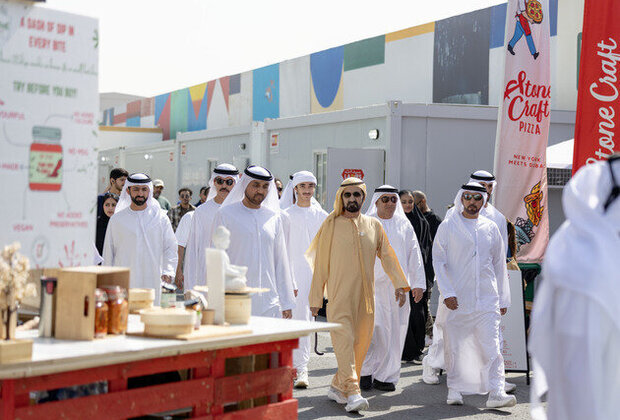
 Sheikh Mohammed bin Rashid Al Maktoum, Vice President and Ruler of Dubai, paid a visit to Quoz Arts Fest during its 14th edition, moving through galleries, studios and outdoor installations across Alserkal Avenue and the wider Al Quoz Creative Zone, underscoring official backing for the city’s cultural economy and creative industries.
During the walkabout, Sheikh Mohammed engaged with artists, curators and organisers, pausing at exhibition spaces and performance venues that have become fixtures of the annual festival. His presence highlighted the role Quoz Arts Fest has assumed as a platform where local and international creatives intersect with the public, businesses and policymakers in a dense industrial quarter transformed into a cultural district.
The visit came as the festival marked its fourteenth iteration, reflecting sustained growth from a neighbourhood initiative into a citywide cultural moment. Quoz Arts Fest has expanded in scale and scope over the years, drawing audiences to visual arts, design, music, film screenings, talks and culinary pop-ups that activate warehouses and open yards. Organisers say the model has helped democratise access to art by keeping entry free and programming family-friendly.
Sheikh Mohammed’s tour spanned multiple venues within Alserkal Avenue, a privately owned arts hub that has anchored Al Quoz’s creative shift. The district hosts galleries, non-profit arts organisations, design studios and independent cafés, and has become a reference point in regional conversations about adaptive reuse of industrial spaces. The Ruler’s interaction with tenants and visitors signalled recognition of that ecosystem’s contribution to Dubai’s broader diversification agenda.
In remarks shared by the organisers, the visit was framed as an affirmation of Dubai’s commitment to culture as an economic driver as well as a social good. Cultural authorities have long positioned creative industries as a pillar alongside trade, tourism and technology, with policy support ranging from long-term visas for creatives to grants and public commissions. Al Quoz, once defined by warehouses and labour camps, has been a testing ground for this strategy.
Quoz Arts Fest itself has mirrored shifts in audience tastes and artistic practice. Programming has moved beyond gallery openings to include experimental performances, public art and cross-disciplinary collaborations, reflecting global trends in festival-making. The emphasis on participation—workshops, talks and live demonstrations—has broadened the festival’s reach beyond collectors to residents and families.
The Ruler’s presence also drew attention to the role of private initiatives in shaping the cultural map. Alserkal Avenue’s development has been largely market-driven, with investment in infrastructure and programming preceding formal zoning changes. That approach has influenced similar projects across the Gulf, where cultural districts are increasingly seen as catalysts for urban regeneration rather than isolated landmarks.
Artists and curators attending the festival said the visit carried symbolic weight. For practitioners working in a competitive global market, visibility at the highest level can translate into confidence for patrons, partners and international collaborators. It also reinforces the message that experimentation and independent practice have a place within the city’s development narrative.
Beyond the Avenue, Sheikh Mohammed’s tour extended to the wider Al Quoz Creative Zone, a designation that brings together government agencies, landlords and tenants to address practical issues such as licensing, logistics and affordability. The zone aims to balance commercial pressures with the needs of artists, a challenge faced by creative districts worldwide as popularity drives up rents.
Topics
Live News