
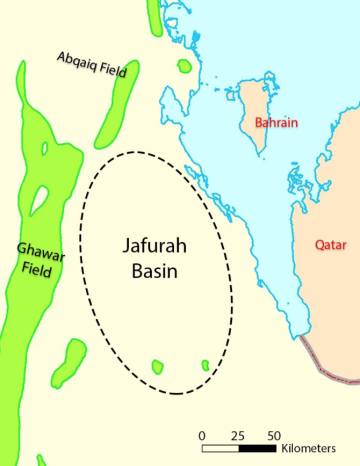
The Jafurah field spans roughly 17,000 square kilometres in Saudi Arabia’s Eastern Province and holds an estimated 229 trillion standard cubic feet of raw gas. The project’s lifecycle investment is expected to exceed $100 billion, reflecting the Kingdom’s ambition to shift domestic energy consumption toward gas and free more crude oil for export.
More than just dry gas, Jafurah’s full output profile is designed to supply the feedstock for the petrochemical industry. By 2030 the plant is projected to produce approximately 420 million standard cubic feet of ethane per day and nearly 630,000 barrels per day of natural-gas liquids and condensates. These by-products will be routed to fractionation and export facilities — including a fractionation plant at Riyas and enhanced condensate handling at Juaymah — to support downstream industries.
Over the past two years Aramco has steadily assembled the infrastructure underpinning Jafurah’s rise. In mid-2024 the company issued more than $25 billion in contracts covering phase two development for the gas field and upgrades to the national Master Gas System. The phase-two scope includes drilling additional wells, installing compression systems, and constructing pipelines spanning over 1,500 km to integrate Jafurah output into the broader gas network.
As part of its strategy to unlock capital while maintaining control, Aramco recently completed an $11 billion lease-and-leaseback agreement with a consortium led by Global Infrastructure Partners and backed by BlackRock. The agreement concerns the gas processing facilities at Jafurah, now managed under a newly created subsidiary with Aramco retaining a 51 percent majority stake.
Company executives view Jafurah as central to energy transition and economic diversification efforts. Gas produced at the field is expected to increasingly power domestic utilities and industries with lower emissions than crude‐fueled generation. The associated liquids and ethane will feed petrochemical production, hydrogen projects, and other downstream value chains.
Topics
Saudi Arabia