
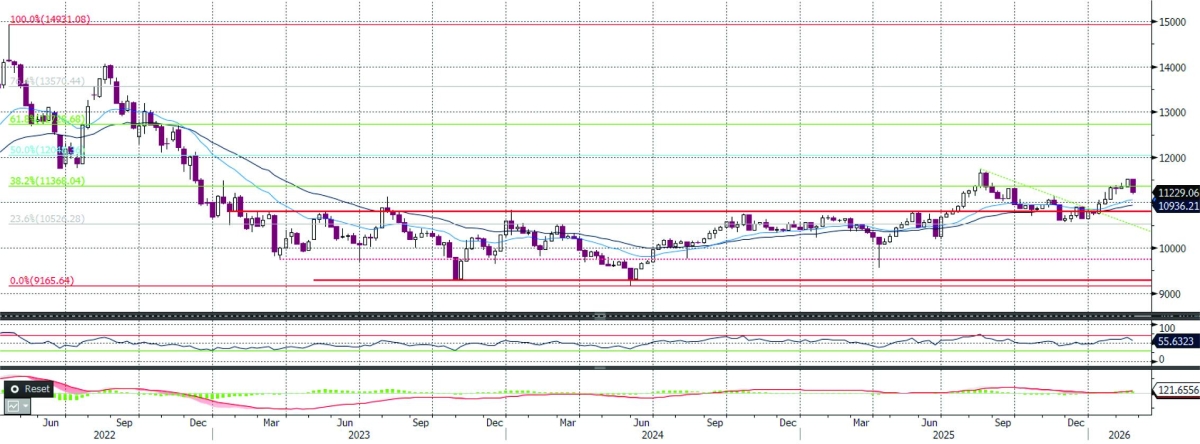
 Qatar Stock Exchange opened the trading week with its strongest advance in weeks, as broad-based buying lifted the benchmark index by 327 points and pushed market capitalisation up by nearly QR20bn.
The 20-stock Qatar Index climbed 3.15 per cent to close at 10,706.7 points on Sunday, recovering sharply from an intraday low of 10,381 points. The move narrowed the market’s year-to-date losses to 0.52 per cent, signalling a marked improvement in risk appetite after weeks of caution linked to regional tension, energy-market disruption and shifting global rate expectations.
Investor sentiment was helped by hopes that diplomatic efforts between Washington and Tehran could ease pressure on the Strait of Hormuz, the key shipping route for Gulf energy exports. The prospect of lower geopolitical risk fed into a wider advance across Gulf equities, with Qatar among the strongest performers as institutional investors returned to large-cap names.
Market capitalisation rose 3.18 per cent to QR640.49bn, driven mainly by gains in large and mid-cap stocks. About 91 per cent of traded constituents ended higher, underlining the breadth of the rally rather than a narrow move led by only a handful of blue chips. Forty-nine companies advanced on the main market, while two declined and three were unchanged.
Banks, transport, real estate and industrials led the advance. The transport sector gained 4.13 per cent, real estate rose 3.58 per cent, banks and financial services climbed 3.55 per cent and industrials added 3.38 per cent. Consumer goods and services, and insurance also closed higher, though their gains were more modest.
QNB, Qatar Islamic Bank, Doha Bank, Industries Qatar, Mesaieed Petrochemical Holding, Qatar Aluminium Manufacturing Company, Gulf International Services, Milaha, Nakilat, Barwa, Ezdan and Baladna were among the major gainers. Qatar Cinema and Film Distribution also moved higher, while Techno Q advanced on the venture market. Al Mahhar Holding and Qatar Islamic Insurance were the only major decliners on the main market.
Foreign institutions turned net buyers by QR57.97mn, a notable shift from net selling in the previous session. Domestic institutions were also net buyers by QR26.68mn, adding to evidence that professional investors used the session to rebuild exposure. Gulf retail investors turned positive, though local retail investors booked profits worth QR57.36mn and Arab individual investors also sold into strength.
Trading activity strengthened alongside the index move. Main-market volumes rose 73 per cent to 221.86mn shares, while traded value increased 45 per cent to QR533.42mn. The number of transactions climbed 21 per cent to 25,889. Exchange-traded funds linked to AlRayan Bank and Doha Bank recorded 0.1mn units worth QR0.27mn across 44 deals, while there was no trading in sovereign bonds, sovereign sukuk or treasury bills.
The rally also lifted wider market measures. The Total Return Index rose 3.15 per cent, the All Share Index gained 3.1 per cent and the Al Rayan Islamic Index advanced 3.01 per cent. The Islamic index’s slower gain reflected a stronger performance from conventional banking and diversified industrial counters during the session.
The advance came against a mixed global backdrop. Energy-market volatility remains a central concern for Gulf investors, particularly after disruptions linked to regional tensions raised shipping, fuel and insurance costs. Qatar’s equity market, however, benefited from expectations that lower geopolitical risk could improve flows into Gulf assets and reduce pressure on transport and trade-linked sectors.
Qatar’s corporate earnings backdrop has also supported investor confidence. Companies listed on the main market reported combined net profits of about $3.5bn for the first quarter of 2026, excluding firms yet to disclose figures at that stage. Banks, industrials and energy-linked companies remain central to the market’s earnings base, while real estate and consumer stocks continue to attract selective interest from investors positioning for domestic demand.
Analysts view the rebound as technically important because it pulled the index back above the 10,700-point level after a period of pressure. Sustained momentum will depend on whether institutional buying continues, whether regional diplomatic signals translate into lower risk premiums, and whether upcoming corporate disclosures reinforce expectations of earnings resilience.
Topics
Qatar