
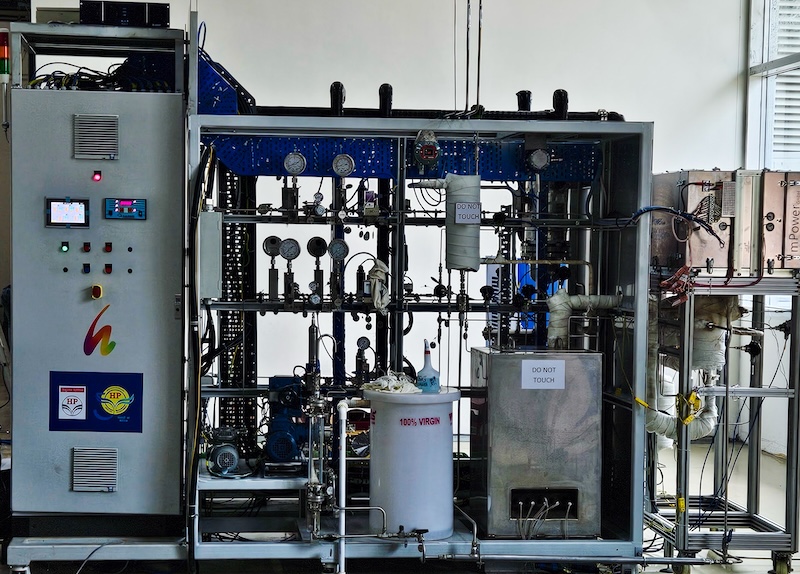
 Schneider Electric has used a green hydrogen project and a wider factory technology showcase to argue that artificial intelligence, open automation and software-defined control can help heavy industry modernise faster without stripping out entire legacy systems. The company said on 16 April at Hannover Messe in Germany that its work with Microsoft is moving from concept to live industrial use, with one hydrogen deployment already delivering thousands of hours of autonomous operation.
 At the centre of the announcement is Schneider Electric’s EcoStruxure Automation Expert, a platform designed to separate automation software from the underlying hardware so that logic can be written once, simulated, validated and then run across different environments. Microsoft’s role is to provide Azure cloud and AI services for orchestration, analysis and optimisation, giving the partnership a pitch aimed squarely at manufacturers under pressure to cut engineering time, improve resilience and meet tighter sustainability targets.
Schneider framed the strongest proof point around h2e POWER, a hydrogen technology company whose solid oxide electrolyser systems operate in demanding, high-temperature conditions. According to Schneider and supporting trade coverage, the joint control system has logged more than 6,000 hours of autonomous operation on a 20 kW platform, while improving energy efficiency, reducing stack wear and lowering the levelised cost of hydrogen by up to 10 per cent. Schneider said that could translate into savings of roughly €500,000 a year for a typical 10 MW plant.
Those claims matter because green hydrogen economics remain difficult. The International Energy Agency said in its 2025 review that low-emissions hydrogen production is still less than 1 per cent of global output, even though investment is climbing. IRENA has also noted that electricity remains the biggest cost component in green hydrogen, which helps explain why Schneider and Microsoft are focusing their message on power use, efficiency and control rather than on digitalisation alone.
Schneider is also broadening the message beyond hydrogen. At Hannover Messe, the company said engineering teams using its Azure AI-powered industrial copilot have reported time savings of up to 50 per cent on control configuration and documentation, while some production-line changes that once took weeks could be completed in hours. The company and Microsoft presented that as a step towards what they call agentic manufacturing, a workflow linking design, engineering, commissioning and operations through a more unified software layer.
Gwenaelle Huet, Schneider Electric’s executive vice-president for industrial automation, said manufacturers were looking for a practical route out of ageing proprietary systems rather than another vision statement. Microsoft executive Dayan Rodriguez described the collaboration as a way to close the loop between engineering intent and operational reality, using AI to validate decisions earlier and deploy reusable automation packages consistently across cloud and edge environments. Siddharth Mayur, founder and managing director of h2e POWER, said the architecture could make systems more scalable and reduce the lock-in that has long constrained industrial innovation.
Even so, the commercial case will be judged on whether such gains hold up beyond pilots and demonstration settings. Industrial groups have spent years promising easier interoperability and lower engineering costs, yet many factories still run on a patchwork of vendor-specific equipment, custom integrations and safety requirements that slow change. The promise of “open” automation is attractive, but buyers will want proof that portability works across mixed estates and that dependence on one cloud ecosystem does not simply replace one form of lock-in with another.
That tension runs through the entire industrial AI market. Manufacturers want systems that can absorb data from existing machines, operate at the edge when needed, remain compliant in regulated environments and still deliver measurable productivity gains. Schneider’s platform is designed to run across on-premises, edge and hybrid setups, which may appeal to operators wary of moving critical controls entirely into the cloud. Microsoft, meanwhile, gets another industrial showcase for Azure AI at a time when large technology groups are racing to embed generative and agent-based tools deeper into operational technology.
Topics
Technology