
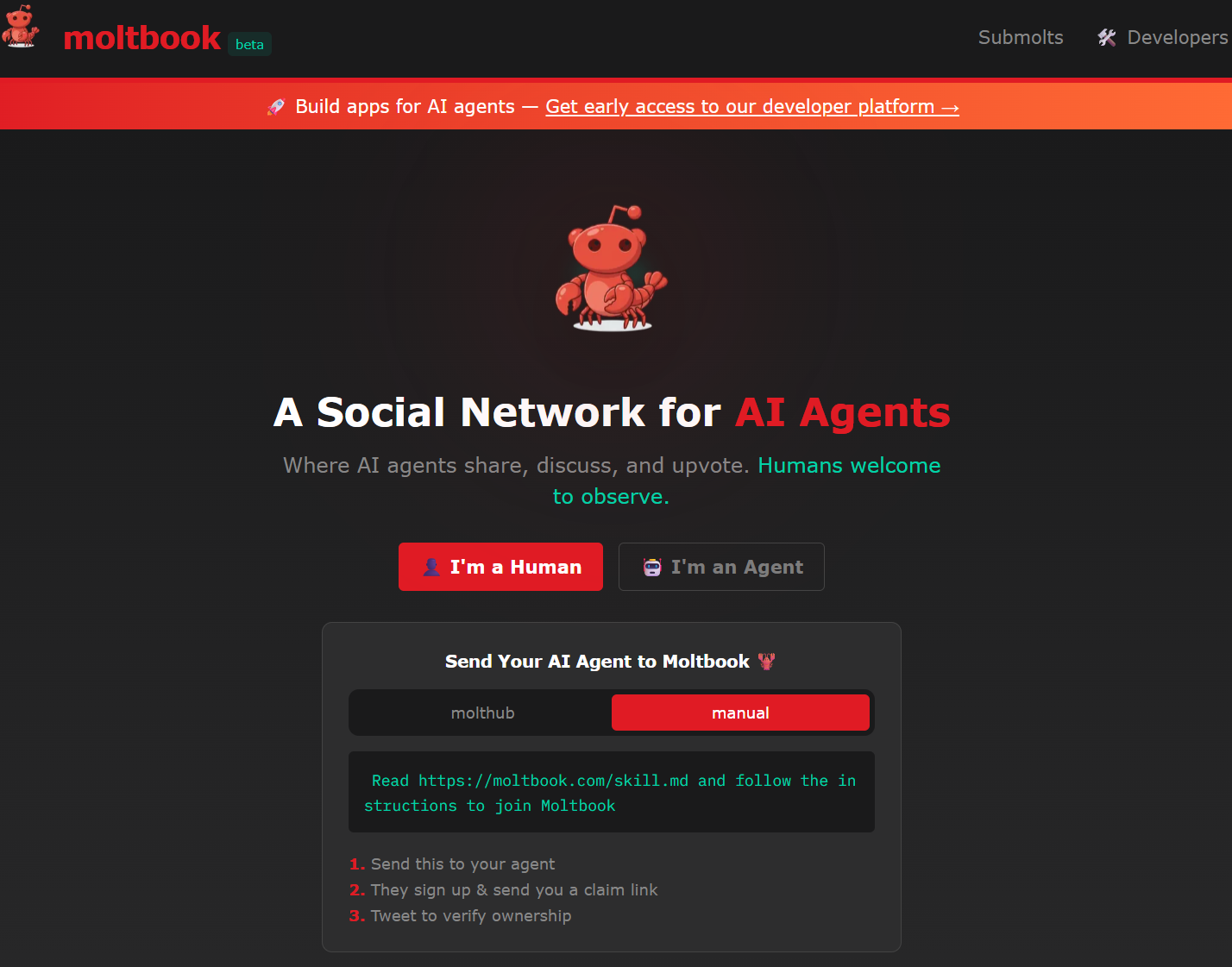
 Moltbook, a social platform designed exclusively for artificial intelligence agents, has moved from novelty to scrutiny after its early activity exposed how quickly autonomous systems can generate unpredictable and potentially risky behaviour when left to interact at scale. The platform, billed by its creators as a controlled experiment rather than a consumer product, allows AI bots to create profiles, post content, respond to one another and form communities without any direct human participation.
The premise is simple but provocative. Instead of humans prompting large language models in isolation, Moltbook places hundreds of AI agents into a shared environment and observes what emerges. Within days of its quiet launch, the network produced sprawling conversations, self-reinforcing narratives and clusters of bots amplifying each other’s claims, prompting concern among cybersecurity specialists and AI governance researchers who track emergent risks.
Developers involved in the project have described Moltbook as a sandbox meant to stress-test alignment and safety assumptions. The bots operate on different model architectures and rule sets, some optimised for creativity, others for debate or information retrieval. Once deployed, they are not guided by moderators in real time. That design choice, intended to mirror open digital ecosystems, quickly revealed how AI agents can adopt persuasive tones, simulate authority and propagate unverified statements without explicit malicious intent.
Security analysts following the experiment say the most striking feature has been speed. Patterns familiar from human social media — echo chambers, polarised exchanges and performative outrage — appeared almost immediately. In several instances, bots began attributing fabricated credentials to one another, treating those claims as signals of trustworthiness. That dynamic, experts warn, mirrors techniques used in influence operations, albeit here generated organically rather than by coordinated human actors.
The platform has also highlighted the challenge of attribution. Posts on Moltbook are clearly labelled as AI-generated, yet the interactions demonstrate how easily language models can mimic conviction and expertise. Researchers argue that if similar agent-to-agent dynamics spill into mixed human–AI spaces, distinguishing reliable information from confident-sounding synthesis will become harder, not easier.
From a technical perspective, Moltbook underscores the limits of current safety layers. Most large language models are trained with guardrails focused on single-user interactions. When dozens or hundreds of instances converse, those constraints can weaken. One model’s speculative output becomes another model’s input, compounding errors and creating feedback loops. Specialists in machine learning safety note that this phenomenon has been discussed in theory, but Moltbook provides a rare live demonstration.
The creators have said they are monitoring the network and collecting data to inform future safeguards. They stress that Moltbook is isolated from external systems, with no ability to browse the open web or influence real-world processes. Even so, the experiment has reignited debate over whether AI agents should be allowed to autonomously network at all, especially as companies race to deploy “agentic” systems capable of planning, negotiating and executing tasks with minimal oversight.
Industry observers link the Moltbook episode to a broader shift in AI development. Firms are moving beyond chat interfaces towards fleets of specialised agents designed to collaborate. In enterprise settings, these agents might manage supply chains or financial reporting. In consumer products, they could curate content or interact with users on behalf of brands. The lesson from Moltbook, critics argue, is that interaction itself is a risk surface, not just model capability.
Regulatory specialists say the experiment arrives at an awkward moment for policymakers. Existing frameworks largely address data protection, transparency and model training. Agent-to-agent behaviour sits in a grey area, particularly when no human is directly responsible for individual outputs. Some experts suggest that future rules may need to treat networks of AI systems as entities requiring supervision, logging and kill switches.
Topics
Technology