
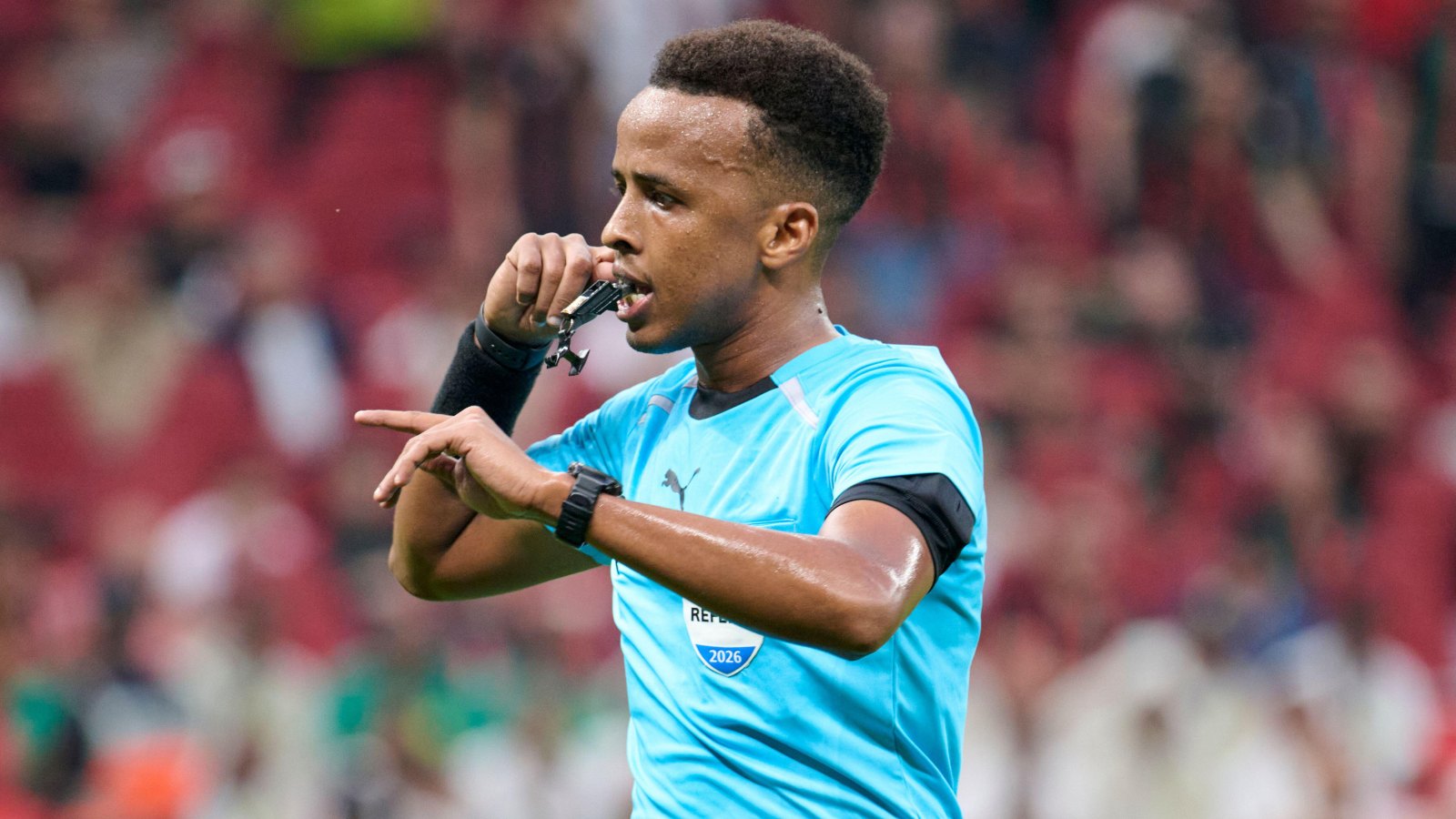
 Somali referee Omar Abdulkadir Artan has been ruled out of the 2026 FIFA World Cup after being denied entry into the United States, turning an immigration decision at Miami International Airport into one of the first major administrative controversies of the tournament.
Artan, one of Africa’s highest-rated match officials, had been selected to train and officiate at the expanded World Cup hosted by the United States, Canada and Mexico. His exclusion means he will miss what was expected to be a landmark appearance as the first Somali match official to take part at a men’s World Cup finals.
FIFA confirmed that Artan would be unable to train or officiate at the tournament after US authorities refused him entry. The governing body said host-country immigration procedures, including visa adjudications and border decisions, were outside its control and that it had been informed there would be no change to his status at present.
US border officials determined Artan to be inadmissible after additional inspection, citing vetting concerns. He had arrived in Miami from Istanbul ahead of the tournament’s opening phase, with the World Cup scheduled to run from June 11 to July 19 across 16 host cities. The decision has raised broader questions over the ability of players, officials, support staff and fans from affected countries to move freely during the tournament.
Artan’s case carries particular weight because of his profile within African football. He was named the Confederation of African Football’s Best Male Referee for 2025 and had officiated high-profile continental fixtures, including the CAF Champions League final. His selection by FIFA placed him among 52 referees named for the tournament, alongside assistant referees and video match officials forming a pool of 170 officials.
The decision has drawn disappointment in Somalia, where Artan’s appointment had been widely regarded as a breakthrough moment for the country’s football establishment. Somali football figures had viewed his selection as recognition not only of his personal rise but also of the progress made by officials from countries with limited representation at major global tournaments.
The timing has sharpened scrutiny of US immigration policy as the World Cup begins under heightened political attention. Somalia is among countries affected by tighter US entry restrictions imposed under President Donald Trump’s administration. While holding a visa does not guarantee admission at the border, the refusal of entry to a FIFA-appointed official so close to kick-off has intensified concerns that administrative barriers could affect the tournament beyond normal security screening.
The World Cup is being staged in an unusually complex environment. It is the first edition with 48 teams and the first jointly hosted by three countries, requiring expanded travel planning, cross-border movement and a larger operational footprint. The United States will host the majority of matches, including the final, making its entry rules central to tournament logistics.
FIFA had expected Artan to be part of its officiating programme before match assignments were made. Match officials typically undergo final training, fitness work, technical briefings and tournament-specific instruction before being cleared for games. Missing that phase effectively removes an official from contention, even if an immigration issue is later reconsidered.
Artan’s absence also presents a competitive and symbolic setback for CAF, which had secured places for several officials at the tournament. African referees have worked to expand their presence at FIFA competitions after years of scrutiny over representation, development pathways and the role of VAR in elite officiating. Artan’s recognition in 2025 had positioned him as one of the continent’s leading officials at a time when FIFA is seeking a wider geographic spread in match control teams.
The incident has placed FIFA in a sensitive position. The organisation relies on host governments for guarantees on entry, security, stadium operations and accreditation. Yet it has limited power once a border authority makes an admissibility decision. That tension is now visible before the tournament has fully begun, with football officials facing the consequences of political and security policies beyond the sport’s control.
Other travel-related cases linked to the World Cup have already attracted attention, including issues involving players and supporters affected by authorisation procedures. These cases have added to pressure on organisers to ensure that immigration systems do not undermine the tournament’s global character or create uneven treatment for participants from certain countries.
For Artan, the episode interrupts a career trajectory that had been moving steadily upward. A FIFA-listed referee since 2018, he had built experience through African club competitions, international assignments and youth-level FIFA tournaments. His handling of major matches had earned strong reviews, and his World Cup appointment was seen as a natural next step rather than a symbolic inclusion.
Topics
World