
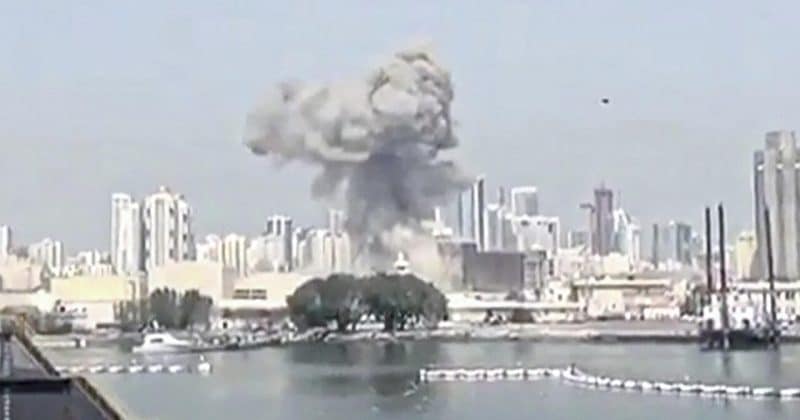
 Jordanian air defences shot down five missiles launched from Iran towards the Azraq area in Zarqa Governorate, preventing a strike on one of the kingdom’s most sensitive military zones as the confrontation between Tehran and Washington widened across the region.
The Jordanian Armed Forces-Arab Army said the missiles were intercepted late on Tuesday before reaching their target. Debris from the interceptions fell inside Jordanian territory, but no casualties or material damage were reported. The military said its air defence units remained on high alert and would continue to respond to any projectile or aircraft violating the kingdom’s airspace.
The attempted strike appeared to target the Muwaffaq Salti Air Base near Azraq, a key installation east of Amman that has hosted US military aircraft and personnel. The base has long been central to coalition operations in the region and has become a focal point in the expanding exchange of fire involving Iran, the United States and US-aligned Gulf states.
Iran’s Islamic Revolutionary Guard Corps said it had launched missile and drone attacks against US military positions in Jordan, Kuwait and Bahrain in response to US strikes on Iranian military infrastructure near the Strait of Hormuz. Tehran said the attacks were directed at bases used for operations against Iran, while warning regional governments against allowing their territory to be used for hostile action.
The Jordanian interception came hours after US forces carried out strikes on Iranian air defence, radar and command facilities around the Hormuz corridor. The operation followed the downing of a US Apache helicopter near the strait, an incident Washington blamed on Iran. The crew survived, but the incident triggered one of the sharpest military escalations since the ceasefire understandings reached earlier this year.
Jordan has sought to avoid being drawn directly into the conflict while making clear that it will defend its territory. Amman’s position has been complicated by geography, defence partnerships and the presence of foreign military assets on its soil. Iranian missiles and drones launched towards targets in the Levant or Gulf often cross or approach Jordanian airspace, forcing the kingdom to act even when it is not the declared target of the attack.
The latest interception underlines Jordan’s growing role as a buffer state in the region’s air-defence architecture. Its systems have been repeatedly tested during cross-border barrages involving Iran and its allied groups. The kingdom has previously intercepted drones and missiles during attacks linked to the Iran-Israel confrontation and has warned that any projectile entering its skies would be treated as a threat, regardless of origin or intended destination.
Officials in Amman have also been under domestic pressure to balance national security with public unease over the regional conflict. Jordan has a large Palestinian population and has faced periodic protests over the war in Gaza, US military cooperation and regional alignments. The government has framed its air-defence actions as measures to protect citizens, homes and infrastructure rather than participation in any external campaign.
The Azraq area carries particular strategic weight. Located in eastern Jordan, it offers access to air corridors connecting the Levant, Iraq, Syria and the Gulf. The Muwaffaq Salti base has been used for operations against extremist groups and for broader regional surveillance and deterrence missions. Its presence has made the area a potential target whenever Iran seeks to signal that US facilities across the region are vulnerable.
The missile interception also coincided with heightened alerts in other Gulf states. Kuwait said its air defences were engaging hostile aerial targets, while Bahrain reported action against incoming drones. These incidents pointed to a coordinated Iranian attempt to pressure US positions across several countries rather than a single isolated strike.
Energy markets reacted nervously to the escalation because the Strait of Hormuz remains the world’s most important oil transit chokepoint. Any sustained disruption there would affect crude, condensate and liquefied natural gas flows from Gulf producers to Asian and European markets. Oil prices moved higher as traders assessed the risk of further military exchanges and possible restrictions on shipping.
Diplomatic efforts to contain the crisis were under strain as Iran insisted it had the right to respond to US attacks, while Washington argued that its strikes were limited and defensive. Regional governments have called for de-escalation, but the spread of attacks to Jordan, Kuwait and Bahrain showed that the conflict’s operational map is expanding beyond Iranian and US territory.
Topics
MENA