
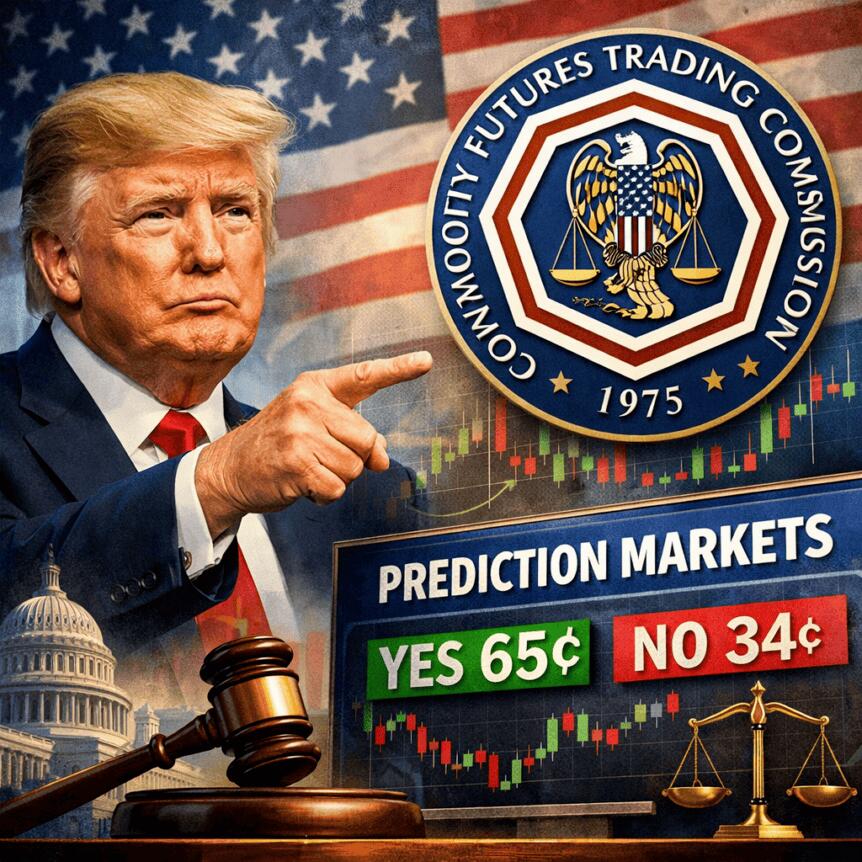
 U. S. President Donald Trump has thrown his weight behind federal control of prediction markets, saying it is “critically important” that the Commodity Futures Trading Commission retain exclusive authority over a fast-growing sector now facing a widening clash with state gambling regulators and courts.
His intervention marks a sharper political defence of prediction-market platforms such as Kalshi and Polymarket, which allow users to trade contracts tied to outcomes in politics, sport, economics, weather and global events. The president’s remarks aligned closely with CFTC Chair Michael Selig’s position that federally regulated event contracts fall within the derivatives framework rather than state betting regimes.
Trump said his administration was setting “rules of the road” for the sector and argued that state-level intervention could undermine the country’s standing as a centre for financial innovation. The comments came as the CFTC fights a series of legal battles over whether prediction markets should be treated as federally supervised derivatives exchanges or as gambling operations subject to state licensing and criminal enforcement.
Minnesota has become the most visible flashpoint after passing a law that would make operating or assisting a prediction market a felony. The CFTC has sued to block the measure before it takes effect on August 1, arguing that the law intrudes on federal jurisdiction over markets listed on designated contract markets. The agency is seeking a preliminary injunction, framing the dispute as a direct test of whether states can restrict products approved under federal commodities law.
The legal terrain has been moving unevenly. Kalshi scored a significant victory in April when a federal appeals court panel backed an injunction preventing New Jersey from enforcing gambling laws against its sports-related event contracts. The court found that Kalshi’s sports contracts were likely swaps traded on a CFTC-licensed exchange, giving the federal regulator exclusive jurisdiction under the Commodity Exchange Act. That ruling strengthened the industry’s argument that state gambling statutes cannot override federal derivatives regulation.
Other courts and regulators have taken a less accommodating view. Nevada temporarily barred Kalshi from offering certain event contracts without gambling licences, while states including Arizona, Connecticut, Illinois and Wisconsin have pursued action against prediction-market operators or challenged their legality. Connecticut accused Kalshi, Robinhood and Crypto. com of running unlicensed sports-betting operations through contract markets, underscoring the breadth of state concern.
The industry’s expansion has drawn heightened scrutiny because prediction markets increasingly blur the line between financial trading, political forecasting and wagering. Supporters say these exchanges produce useful probability signals, improve price discovery and allow hedging against real-world risks. Critics argue that contracts tied to elections, wars, deaths, criminal proceedings or sports outcomes can incentivise harmful conduct, exploit vulnerable users and create pathways for insider trading.
Sports contracts have become a central battleground. The CFTC has moved to build integrity arrangements with major leagues, including information-sharing agreements aimed at detecting fraud, manipulation, insider activity and match-fixing. Such arrangements are designed to show that federal oversight can address the same risks that state gambling agencies say require local licensing.
Political markets add a further layer of controversy. Election-related contracts have a long history of regulatory resistance, but demand for them has surged as traders, campaigns, data firms and media organisations increasingly monitor market-implied probabilities alongside polls. Platforms argue that these contracts provide public information and are not conventional wagers against a bookmaker. Opponents warn that high-stakes political contracts could distort incentives and expose democratic processes to financial manipulation.
Trump’s own political and business orbit has added sensitivity to the debate. His media company has explored prediction-market products, while Donald Trump Jr has been linked to companies active in the sector. Those ties are likely to intensify scrutiny from lawmakers who already question whether federal oversight is sufficiently independent and whether the CFTC has the resources to police a market expanding beyond its traditional commodities and derivatives base.
The CFTC’s position under Selig reflects a broader shift from earlier caution toward active rulemaking. The agency has signalled that new federal standards are needed for event contracts, including clearer safeguards on market integrity, surveillance, customer eligibility and product categories. That effort is intended to prevent a patchwork of conflicting state rules while preserving enforcement tools against fraud and manipulation.
Topics
Cryptocurrency